 Anchor
The noon traffic of Sanciangko Street ground its gears, but inside, under the glare of industrial lights, time seemed to fold.
Ninety-one years is a quiet country. If you live there, your steps slow, your voice thins to dry parchment. But Atty. Augusto W. Go did not sound like a monument on Saturday morning of October 10. He sounded like a man who still stayed awake worrying over other people’s electric bills.
He stood before his people, the teachers who grade blueprints by midnight, the staffs who chase report errors, the working scholars sweeping the corridors long after the dismissal. He told them about a shirt he saw in Washington, D.C., crisp against the American cold: I cannot spell success without U.
The auditorium leaned in.
He started counting UC’s victories like the proud dad who boasts to his kumpares over drinks on a Saturday night. The ocean-going mariners training on world-class decks, the nurses, the engineers, the lawyers, the best IT program in Central Visayas—he placed the university’s trophies on the table, basking glory where it belonged.
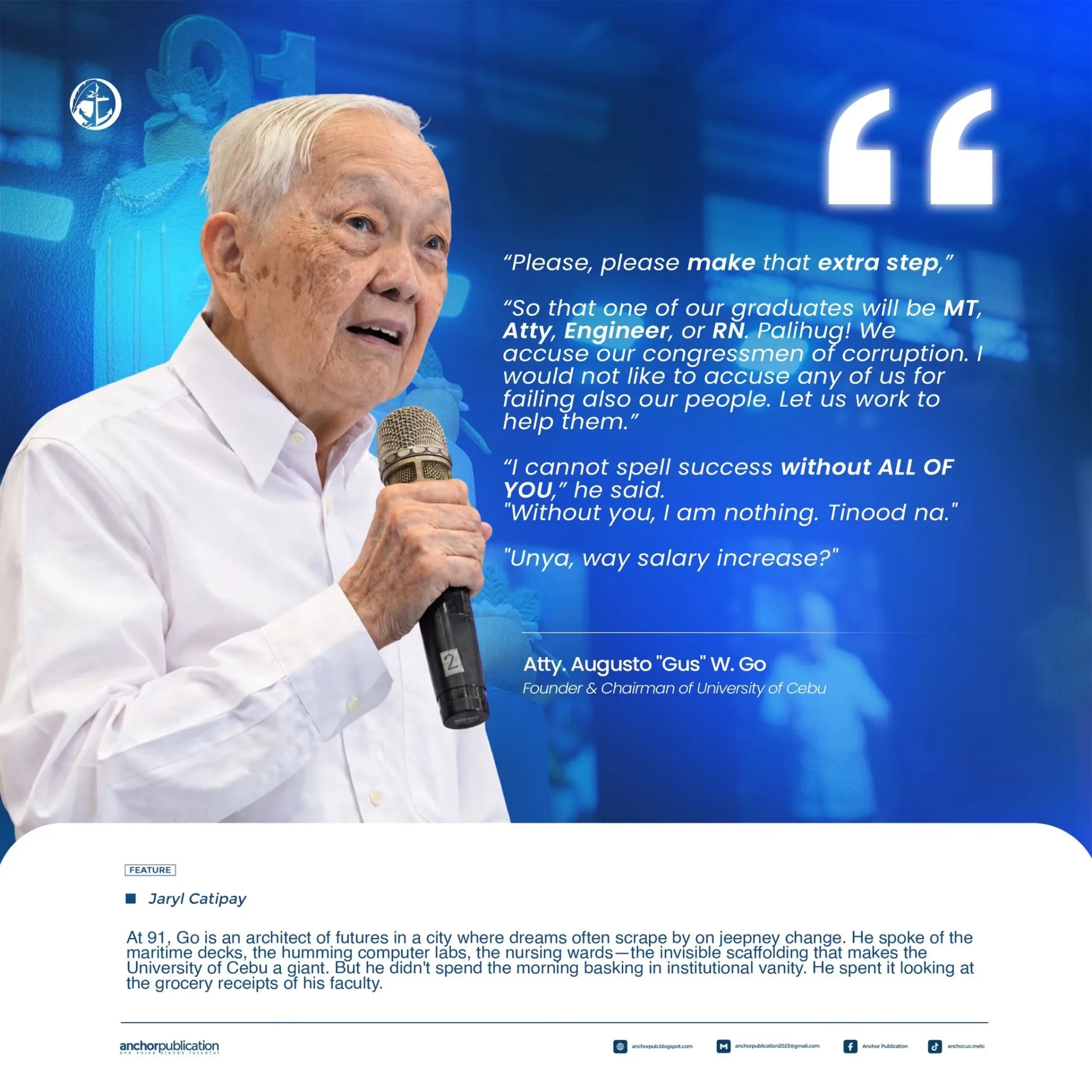
"I cannot spell success without U," he murmured, his voice catching the microphone’s edge with a dry raspy chuckle. Then came the pivot, the sudden, sharp drop into the vernacular that made the room breathe as one. "Unya, way salary increase?"
Laughter broke the tension like a glass dropped on tile. But the joke dissolved instantly into something heavier, something that clung to the rafters.
"I cannot spell success without ALL OF YOU," he said. "Without you, I am nothing. Tinood na."
In Cebu, they just call it kugi.
At 91, Go is an architect of futures in a city where dreams often scrape by on jeepney change. He spoke of the maritime decks, the humming computer labs, the nursing wards—the invisible scaffolding that makes the University of Cebu a giant. But he didn't spend the morning basking in institutional vanity. He spent it looking at the grocery receipts of his faculty.
He knows the weight of a sack of rice. He knows why the classrooms hum with tired energy.
"Please, please make that extra step," he begged them, his hands gesturing with the frantic urgency of a father at a graduation gate. "So that one of our graduates will be MT, Atty, Engineer, or RN. Palihug! We accuse our congressmen of corruption. I would not like to accuse any of us for failing also our people. Let us work to help them."
When tuition hikes are the easy answer to inflation, Go flatly refused them. "Our people are suffering," he said simply. Instead, he took the ledger into his own hands. Beginning October 1, every single employee in the UC system will see an extra 1,300 pesos slip into their pockets each month—roughly a fifteen-million-peso annual promise carved straight out of the institution’s skin. One hundred pesos per load. Small, he admitted. But it is a foothold on a steep slope.
The stands erupted in a spontaneous chorus of Merry Christmas, the well-wishers two months early, overcome with the unbridled relief.
Before the morning closed, he cast his gaze outward, past the university gates, toward the gray waters of the West Philippine Sea.
Before the morning closed, he turned his attention beyond the university gates to announce a new commitment to the nation’s service members: any Philippine Coast Guard personnel injured in the West Philippine Sea can receive free medical treatment at UC Med, while their children will be granted full scholarships across UC campuses—a direct gesture of gratitude to those serving on the front lines.
As Go stepped down the microphone, the ovation rang in the rafters of the old coliseum. The old man had spent his 91st birthday not counting his years but measuring his family’s expenses. In a world enamored with showy displays, this was the old man’s way of saying We stand united.
Words | Jaryl Catipay